If you want to launch an affiliate programme on Shopify in 2026, the best apps right now are UpPromote, ReferralCandy, RecomSale, BixGrow, GoAffPro, Simple Affiliate, LeadDyno, and Affiliatly. These are the tools that consistently come up in testing, merchant reviews, and real-world recommendations because they handle the parts that matter most: tracking, commission rules, affiliate onboarding, and payouts.
As someone who builds Shopify apps for a living, I spend a lot of time looking at how merchants actually use third-party tools once the install is done. In my experience, the best affiliate app is not always the one with the longest feature list. It is the one that matches your store size, your margin, and how hands-on you want to be when managing creators, ambassadors, and referral partners.
In this guide, I have rewritten and expanded our original list to reflect 2026 search intent, current app positioning, and the features merchants now expect as standard. I have also included a comparison table, practical setup advice, and my honest view on which apps are best for beginners, best free option, and best for scaling brands.
What is a Shopify affiliate app?
A Shopify affiliate app is software that helps you recruit affiliates, generate referral links or codes, track attributed sales, and pay commissions. Without an app, running an affiliate programme on Shopify becomes messy very quickly.
At a minimum, a good affiliate app should let you create unique partner links, set percentage or fixed commissions, and view sales and payout reports. Better apps also include fraud checks, custom dashboards, branded portals, automated emails, and direct payout options.
If you are still deciding whether affiliate marketing is right for your store, I would also read our guide to setting up a profitable affiliate programme for Shopify. That article covers the strategy side, while this one focuses on the app you actually use to run it.
Why use an affiliate app instead of managing affiliates manually?
You should use an affiliate app because manual tracking breaks down fast. Once you have more than a handful of partners, spreadsheets and discount code workarounds become unreliable.
Affiliate marketing is attractive because it is performance-based. You usually pay only when a sale happens. But that only works if attribution is accurate, payouts are clear, and affiliates trust your reporting.
In my experience building Shopify apps, merchants often underestimate the operational side. The first 5 affiliates are easy. The next 50 create questions around cookie windows, discount stacking, refund handling, and multi-touch attribution. A proper app gives you a framework for all of that.
Well-run affiliate programmes can generate 10x+ ROI according to 2026 expert roundups, but only when setup and tracking are clean. That is why app choice matters more than most merchants think.
How do I choose the best affiliate app for my Shopify store?
The best affiliate app depends on your growth stage, budget, and affiliate model. A small store usually needs simplicity and a free plan, while a larger brand may need automation, creator recruitment, and advanced payout workflows.
When I evaluate Shopify apps, I usually look at five things first: ease of setup, commission flexibility, payout options, affiliate experience, and Shopify-native usability. Those five factors tell you a lot about whether the app will still work for you six months later.
- Ease of setup - Can you launch in under an hour without developer help?
- Commission models - Does it support percentage, fixed, tiered, and product-specific rates?
- Tracking reliability - Can it track links, codes, post-purchase referrals, and repeat orders properly?
- Payout workflow - Does it support auto-payments, PayPal, gift cards, or manual approval?
- Affiliate portal quality - Do partners get a clean dashboard with links, stats, and creatives?
- Fraud prevention - Can you spot self-referrals, coupon abuse, or suspicious conversions?
- Pricing - Is there a free plan, and does pricing scale sensibly as you grow?
- Support and reviews - High review counts and consistent support quality still matter a lot.
If your store also relies heavily on upsells and post-purchase offers, it is worth pairing your affiliate setup with one of the tools in our best upsell apps for Shopify guide. More revenue per order gives you more room to pay competitive commissions.
What are the best affiliate apps for Shopify in 2026?
The best Shopify affiliate apps in 2026 are UpPromote, ReferralCandy, RecomSale, BixGrow, GoAffPro, Simple Affiliate, LeadDyno, and Affiliatly. These eight stand out because they cover the main use cases from startup stores to established DTC brands.
Shopify’s app marketplace now lists 192 affiliate-related apps, so shortlisting matters. The tools below are the ones I would realistically tell a merchant to test first.
| App | Best for | Pricing | Standout feature |
|---|---|---|---|
| UpPromote | Most stores overall | Free to $199.99/month | Strong free plan and polished partner portal |
| ReferralCandy | Referral plus affiliate programmes | From $29/month | Automated rewards and customer referrals |
| RecomSale | Stores wanting simplicity inside Shopify | Free to $49/month | Affiliate and referral tools in one dashboard |
| BixGrow | Budget-conscious brands | Free to $24.99/month | Low-cost plans with solid core features |
| GoAffPro | Best generous free option | Free tier available | Unlimited affiliates on free plan |
| Simple Affiliate | Ease of use and payouts | Free to $69/month | Very straightforward setup and tax handling |
| LeadDyno | Non-technical teams | Custom or app store pricing | Fast guided setup |
| Affiliatly | Small ambassador programmes | Low-cost paid plans | Simple basics without extra clutter |
1. UpPromote Affiliate & Referral
UpPromote is the best overall affiliate app for most Shopify stores in 2026. It combines a generous free plan, deep feature coverage, and one of the strongest reputations in the category.
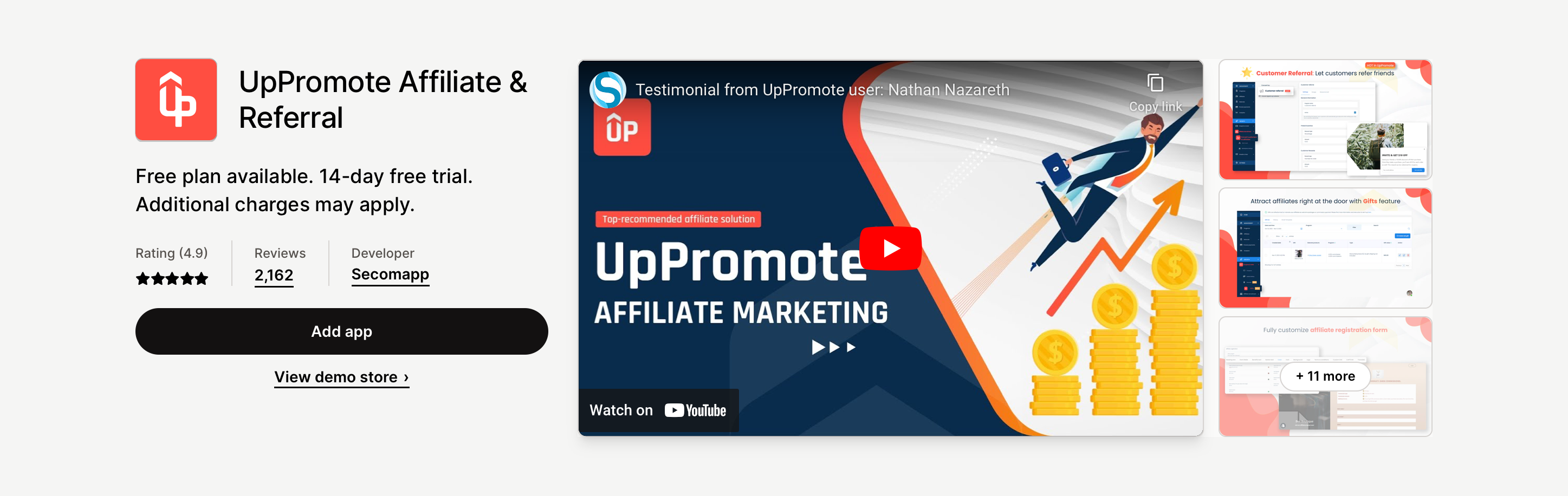

UpPromote Affiliate & Referral is the app I would start with for most merchants. It has a 4.9-star rating from 2,700+ reviews, supports unlimited affiliates on the free plan, and includes the features that smaller stores usually outgrow in cheaper tools.
When I tested similar affiliate setups for Shopify stores, the biggest friction point was usually affiliate onboarding. UpPromote handles that well with a professional partner portal, easy link generation, coupon support, and built-in email flows. It also includes PayPal auto-payments and fraud protection, which are not always available at the lower end of the market.
Pricing starts free and scales up to $199.99/month. That makes it suitable for new stores, but also strong enough for brands that need tiered commissions, ambassador workflows, and larger partner rosters.
- Best for: Most stores, especially those wanting room to grow
- Pros: Excellent free plan, polished UI, strong reviews, referral features included
- Cons: Advanced setups can still take time to configure properly
My verdict: Best overall. If you only test one app first, make it this one.
2. Referral Candy & Affiliate
ReferralCandy is best if you want customer referrals and affiliate marketing in one mature platform. It is especially strong for brands that want to turn existing customers into advocates.
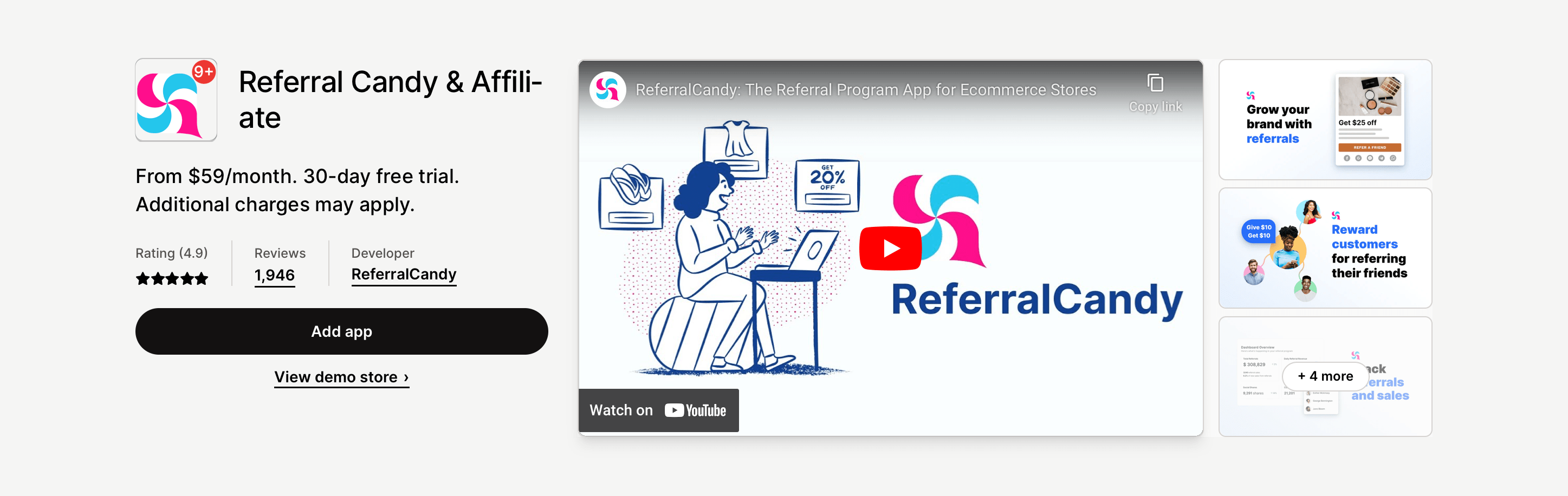

Referral Candy & Affiliate remains one of the most recognisable names in this space. It starts from $29/month, has a 4.9-star rating, and is often chosen by brands that care as much about customer referral loops as they do about traditional affiliate recruitment.
The key strength here is automation. You can create personalised referral links, automate rewards, run tiered commissions, and pay partners through options such as PayPal, Venmo, or gift card-style rewards through integrations like Tremendous. For stores with repeat purchase behaviour, that can be very effective.
I also like that ReferralCandy integrates neatly with popular ecommerce tools. If your retention stack already includes email or subscription apps, it tends to slot in well. For merchants focused on reducing paid ad dependence, it is a compelling option.
- Best for: Referral-led brands and customer advocacy programmes
- Pros: Mature platform, strong automation, referral and affiliate support together
- Cons: Can be more expensive over time depending on usage and add-ons
My verdict: Best all-in-one for referrals plus affiliates.
3. RecomSale
RecomSale is one of the more interesting newer-style options for merchants who want a clean, Shopify-centric setup. It balances simplicity and useful features without overwhelming smaller teams.
RecomSale is highlighted in multiple 2026 expert comparisons as a strong pick for stores that want to manage affiliate marketing and customer referrals together. Pricing runs from free to $49/month, which is sensible for smaller brands.
Its appeal is that the onboarding flow and dashboard are intuitive. You can customise signup, track sales, and manage programme activity from within Shopify without feeling like you need a separate affiliate operations tool. That matters more than people think, especially for founder-led stores.
Based on current comparisons, RecomSale is not the most advanced option here, but it is one of the easiest to recommend when a merchant wants a straightforward launch with room for basic growth.
- Best for: Lean teams wanting simplicity inside Shopify
- Pros: Good value, referral support, easy admin experience
- Cons: Less battle-tested publicly than the biggest names
My verdict: Best for simple in-dashboard management.
4. BixGrow
BixGrow is one of the best low-cost affiliate apps for Shopify in 2026. It is a strong option if you want core features without paying premium app prices.
BixGrow is commonly recommended as the cheapest capable option. It offers plans from free to $24.99/month, while still covering essentials like affiliate tracking, referral programmes, custom portals, and fraud protection.
For newer stores, that pricing is attractive because affiliate programmes often start slowly. You may not want to commit to a tool costing £50 to £150 per month before you know whether creators or ambassadors will actually move the needle for your products.
In practical terms, BixGrow gives you enough to launch professionally without overcommitting. The trade-off is that it may not feel as polished or expansive as UpPromote or ReferralCandy, but for many merchants that is perfectly fine.
- Best for: Cost-conscious stores and early-stage brands
- Pros: Very affordable, includes referral features, useful fraud controls
- Cons: Less premium feel than top-tier alternatives
My verdict: Best budget option if you still want a proper feature set.
5. GoAffPro
GoAffPro is the best free-first affiliate app for Shopify if your priority is scale without upfront cost. Its free tier is one of the biggest reasons it remains so widely recommended.
GoAffPro is known for offering unlimited affiliates and unlimited sales on its free tier. That is rare. It also supports multi-level commissions and more flexible payout structures than you might expect at that price point.
The main caveat is usability. Most expert reviews in 2026 say the interface feels a bit dated compared with newer competitors. I think that is fair. In the Shopify ecosystem, merchants increasingly expect apps to feel native, clean, and easy to train staff on.
Still, if your budget is tight and you need to test affiliate marketing seriously before investing, GoAffPro is very hard to ignore.
- Best for: Stores wanting the most generous free plan
- Pros: Unlimited scale on free tier, flexible commissions, strong value
- Cons: Interface is not as polished as top competitors
My verdict: Best free option for merchants who can tolerate a less modern UI.
6. Simple Affiliate
Simple Affiliate is the easiest affiliate app for Shopify if you want a clean setup and minimal friction. It is a good fit for merchants who value clarity over complexity.

Simple Affiliate is often described as the easiest tool in the category, and I can see why. Pricing runs from free to $69/month, the dashboard is straightforward, and the payout flow is designed to reduce admin work.
One standout feature is that it supports auto-payouts without requiring PayPal, and it also helps with 1099 tax form handling for affiliates. That makes it especially useful for US-based merchants managing a serious creator or ambassador programme.
If you are the sort of merchant who hates fiddly settings pages and wants to get from install to launch quickly, this is one of the strongest options on the list.
- Best for: Merchants who want the easiest setup experience
- Pros: Very simple UX, useful payout tooling, tax admin support
- Cons: Not the broadest ecosystem or feature set compared with category leaders
My verdict: Best for simplicity and operational ease.
7. LeadDyno
LeadDyno is best for non-technical teams that want a guided setup and a more hands-off launch. It focuses heavily on getting you running quickly.
LeadDyno is often mentioned in 2026 roundups because of its 15-minute setup wizard and beginner-friendly approach. If you are not especially technical, or if marketing is being managed by a small team without dedicated ecommerce ops support, that matters.
It covers the basics you would expect: commission setup, tracking, and affiliate management. Where it wins is confidence. Some apps feel powerful but opaque. LeadDyno tends to feel more guided, which reduces launch anxiety for newer merchants.
I would not call it the most exciting app on this list, but I would call it practical. Sometimes that is the better choice.
- Best for: Non-technical merchants and quick onboarding
- Pros: Guided setup, easy to understand, low learning curve
- Cons: Less often chosen by advanced operators seeking deeper flexibility
My verdict: Best for hands-off setup.
8. Affiliatly Affiliate Marketing
Affiliatly is best for small ambassador programmes that just need reliable basics. It does not try to be everything, and that is exactly why some merchants like it.

Affiliatly Affiliate Marketing is regularly described as the cheapest paid option for merchants who want no-nonsense functionality. It covers click tracking, sales tracking, and commission management, and its pricing scales more by affiliate count than by locking away core features.
That makes it a sensible fit if you only plan to work with 10 to 20 ambassadors or a small creator roster. You are not paying for marketplaces, discovery tools, or heavyweight automation you may never use.
In my experience, many stores overbuy on software. Affiliatly is a reminder that sometimes a simple app with dependable basics is enough.
- Best for: Small stores with a modest affiliate roster
- Pros: Affordable, simple, focused on essentials
- Cons: Lacks some of the extras found in newer all-in-one platforms
My verdict: Best for small ambassador programmes.
How does Shopify Collabs compare with dedicated affiliate apps?
Shopify Collabs is useful for creator partnerships, but it is not always the best dedicated affiliate app. It works well for some brands, especially those already invested in Shopify’s native ecosystem.
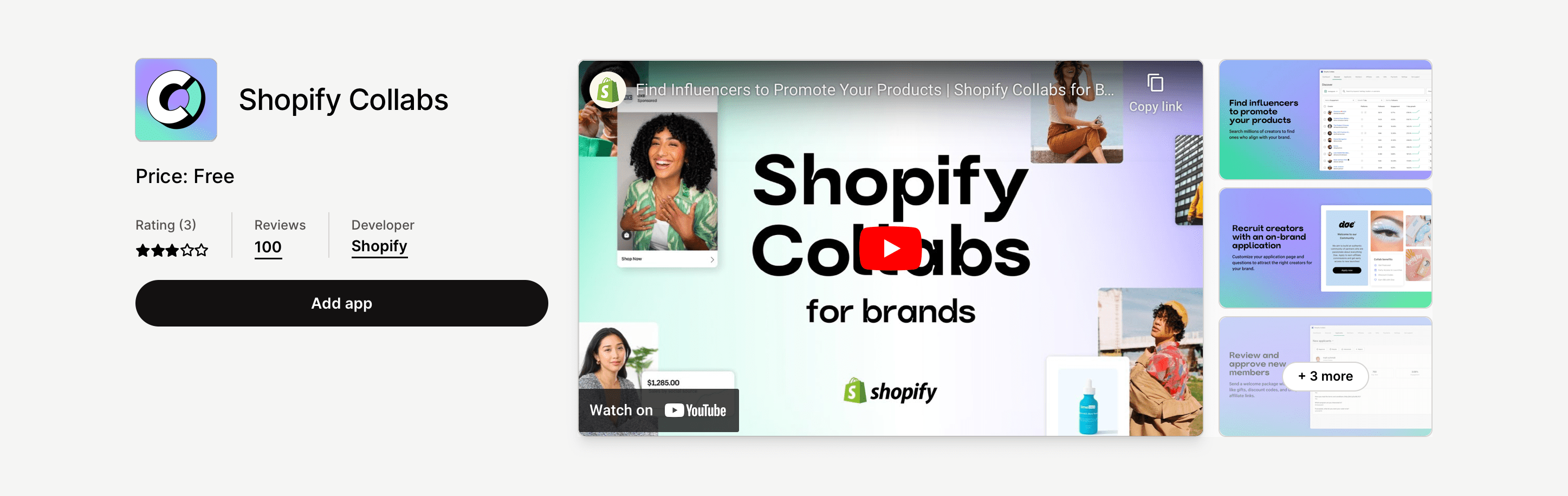

Shopify Collabs is free to install and is built by Shopify, which gives it an obvious advantage in trust and native integration. It is designed around creator recruitment, gifting, affiliate offers, and automatic payouts.
For some merchants, especially creator-led DTC brands, that is enough. But I have found that dedicated affiliate apps still tend to offer more depth around commission logic, referral workflows, reporting, and programme customisation. Collabs is good, but it is not automatically the best fit just because Shopify built it.
If your strategy is heavily influencer-led and you want a native-feeling tool, it is worth testing alongside one of the dedicated apps above. If you need more traditional affiliate programme controls, I would usually start elsewhere.
Which Shopify affiliate app is best for your store size?
The right app changes depending on whether you are a startup, a growing DTC brand, or an established store with a larger partner network. Matching the app to your stage will save you money and replatforming headaches.
| Store type | Recommended app | Why |
|---|---|---|
| New store with limited budget | UpPromote or GoAffPro | Free plans and enough features to validate the channel |
| Small brand wanting easy setup | Simple Affiliate or RecomSale | Cleaner workflows and less admin friction |
| DTC brand focused on referrals | ReferralCandy | Strong customer referral automation |
| Budget-conscious scaling store | BixGrow | Low monthly cost with useful core features |
| Small ambassador roster | Affiliatly | Reliable basics without overpaying |
If you run a one-product brand, affiliate marketing can work especially well because the offer is easier for creators to explain. Our guide to useful apps for a one product store on Shopify pairs nicely with this topic.
How do I set up an affiliate programme on Shopify properly?
The best way to set up a Shopify affiliate programme is to start simple. Pick one app, define a commission structure, create clear partner terms, and recruit a small first batch before you scale.
- Choose your app based on budget, complexity, and payout needs.
- Set your commission structure - percentage, flat fee, or tiered rates.
- Decide attribution rules - cookie window, discount code rules, and repeat purchase eligibility.
- Create an affiliate signup page with clear expectations and approval criteria.
- Prepare partner assets such as images, product angles, and swipe copy.
- Test tracking yourself before inviting anyone. Never skip this step.
- Start with 10 to 20 partners and review conversion quality before scaling recruitment.
- Pay on time and communicate clearly. Good affiliates stop promoting unreliable brands quickly.
One of the biggest mistakes I see is merchants setting commissions without checking margins. If you already use discount-heavy promotions, shipping offers, or post-purchase incentives, the maths can get tight. Work backwards from your real contribution margin, not your top-line revenue.
If your store depends on product page persuasion, it is also worth improving that before recruiting affiliates. Better conversion rates make every affiliate click more valuable. I would suggest our guide to the best product detail page apps for Shopify if you need help there.
What mistakes should I avoid when choosing an affiliate app?
The most common mistake is choosing an app based only on price. The cheapest app is not the cheapest if it creates payout errors, affiliate confusion, or poor tracking.
- Ignoring payout workflows - Manual payouts become painful faster than most merchants expect.
- Overcomplicating commissions - Start simple before adding tiers, exclusions, and bonuses.
- Not checking refund handling - You need to know what happens to commissions on returned orders.
- Skipping fraud controls - Self-referrals and coupon abuse are common.
- Choosing based on features you will never use - More is not always better.
- Not testing affiliate UX - If the dashboard is confusing, recruitment gets harder.
In my experience, ease of ongoing management matters more than feature count. A slightly simpler app that your team actually uses well will usually outperform a more advanced one that nobody fully understands.
What is my final verdict on the best affiliate apps for Shopify in 2026?
UpPromote is still the best overall choice for most Shopify merchants in 2026. It offers the strongest blend of pricing, usability, reviews, and scale.
If I were advising a new merchant today, I would shortlist apps like this:
- Best overall: UpPromote
- Best for referral-led growth: ReferralCandy
- Best free option: GoAffPro
- Best budget paid option: BixGrow
- Best for simplicity: Simple Affiliate
- Best for small ambassador programmes: Affiliatly
The good news is that Shopify merchants have far better options now than they did a few years ago. The category is more competitive, app quality is higher, and there are strong choices at both the free and premium ends of the market.
If you are serious about building a channel that compounds over time, an affiliate programme is still one of the smartest bets in ecommerce. Just make sure the app you choose fits the way your store actually operates, not just the way you hope it will operate later.